Showing posts with label Spain and Portugal. Show all posts

Thursday, 3 October 2013

Mas Martinet: A glimpse into the 2013 harvest

Posted by Julian Campbell, Buyer
A beautiful day to start the harvest
Let the picking begin!


Priorat harvest is very slow as all the vineyards are in different locations and different climatic zones.


To introduce the harvest stages it is tradition at Mas Martinet to make paella for all the team as a great start to a new season!


A well deserved break enjoying paella and Mas Martinet wines of course.


Only the very best grapes are selected.


Grenache from Pesseroles going into the Fermenation process.


So far quality this year seems to be really good but not much quantity!


Thursday, 26 July 2012

Spain 2009 Vintage - Buying Trip Report

Posted by Julian Campbell, Buyer
Spain may be a country facing all number of economic problems, but boy does it have some serious winemaking talent. Our most recent trip, a whirlwind tour that involved many hours behind the wheel, took us from Ossian's sandy, pre-phylloxera vineyards in Rueda, up to the wild west of Ribera del Duero, up and futher across to San Vicente in Rioja and then finally all the way east to Catalonia and the hot, dry hills of Priorat.

En route we encountered breathtaking countryside, big skies and huge vistas, soaring buzzards, warm people, old vines and low yields, plenty of delicious ham and even more delicious wine. In what feels like Hemmingway country there are wines being made that offer such pure, ripe, complex, silky seduction it is amazing they are not more highly sought after over here in the UK market.

Arid soils in Ribera del Duero
Three major factors crop up again and again. Old vines, warm, dry, sunny and most importantly disease inhibiting weather, and experimentation. At not a single one of the domaines that we visitied were we not shown something new; a technique, a decision, a new bottling, amphorae, a new training method, straw between the vines to keep the soil cool. Perhaps because the new wave of Spanish winemaking is a relatively recent phenomenon, there is a buzz and a can do/will do attitude to be found that is both infectious and exciting.

In Ribera and Rioja the 2009 vintage has produced silky sumptuous wines that have luscious textures but no lack of freshness. It is a highly successful vintage. Tasting the wines from Aalto, in their wonderfully modern, architectural Bodega, it was hard not to think that this vintage will see them propelled to even greater popularity. Most definitely one to buy En Primeur.

Over in Rioja the Eguren family continue to rule the roost. Held in the highest regard in Spain, yet still relatively unknown over here, they receive about as much critical acclaim as any of our growers. And for good reason. Traditional plantings, often seriously old, even pre-phylloxera, combined with a modernist outlook in the winery gives wonderful results. And as if there Rioja holdings weren't impressive enough, Marcus Eguren continues to rachet up quality levels at their Toro Estate Teso La Monja. Elegance and power combined - this is Tinto de Toro at its most exquisite.
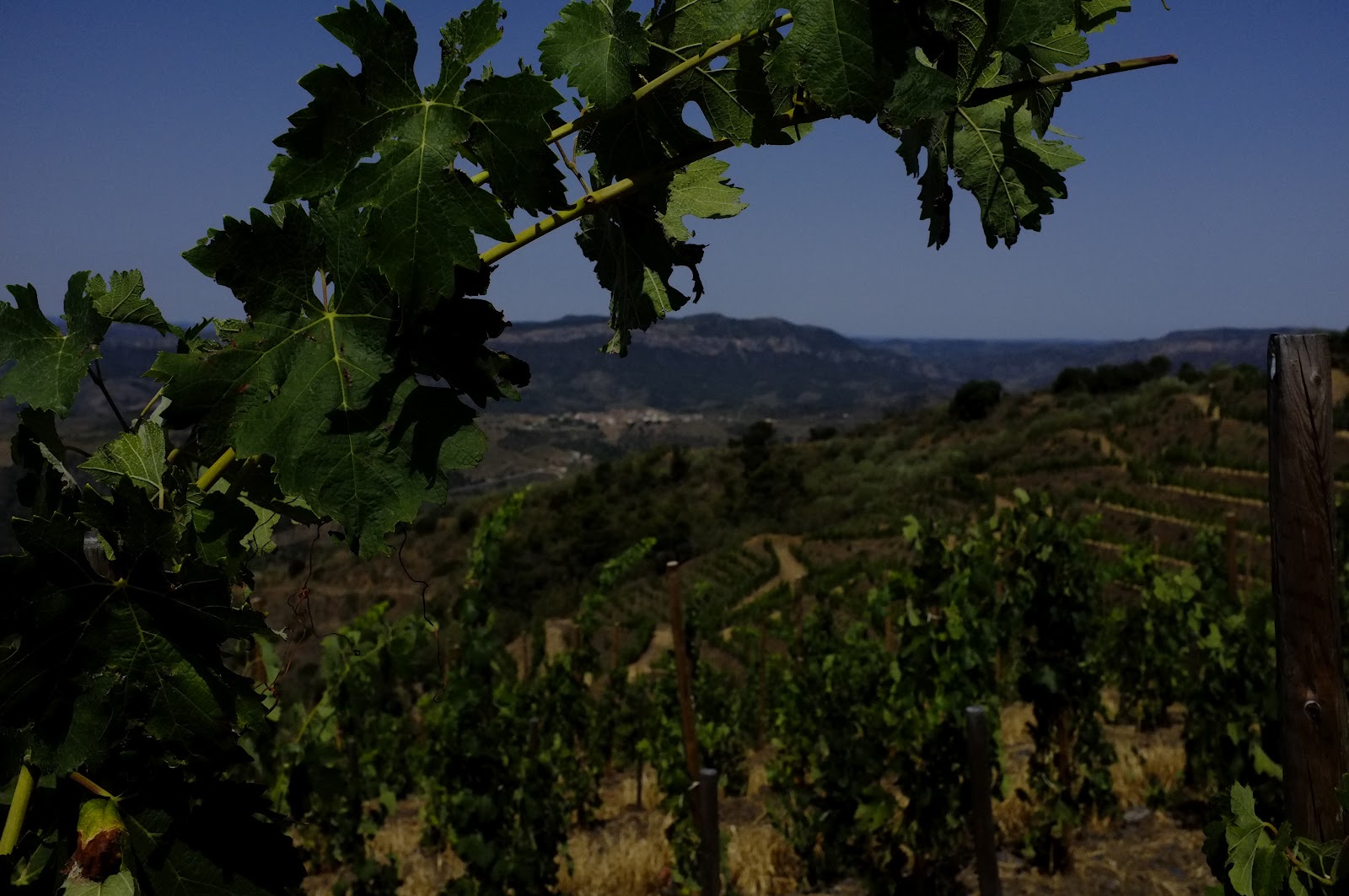
The view from Mas Martinet's Escurcons vineyard. The highest in the region
The hills of Priorat, with their twisty roads and infuriating signage, provide the setting for what must be one of the most dramatic wine regions in the world. Grenache and old Carignan plantings dominate, coming to their absolute best on the crumbly slate "licorella" soils. You see a cross section, with less than a foot of soil before slate begins and you honestly wonder at the vines ability to carve out a life for itself here. This is extreme viticulture, hot and dry, and the results are utterly thrilling. It is also, in it's newest guise, a region of relatively little age, the new wave only beginning in the 1980s, dragging the region out of a period of low economic prosperity. Mas Martinet, Vall Llach and Mas Doix each manipulate a different part of the region. And they all manage to achieve different expressions. In 2009, again hot and dry, there is a certain power to all these priorat wines. Power and intensity. But the greatest benefit the Licorella brings is a mineral spice and freshness to carry that power. This slate, and the clean firm backbone it lends to the wines, really is the essence of Priorat.

Licorella slate heavy soils in Priorat
Excessive talk of the high alcohol content of these wines is to miss the point of their being rooted to and very much of these wild arid hills. A wine harvested prematurely at 13% potential that has not had the chance to fully ripen will never give much pleasure. These great priorats, harvested fully ripe at a degree or two more than that might be alcoholic, but they are also balanced, and profound, and unforgettable.

Monday, 15 August 2011

Spain - Exciting times

Posted by Giles Burke-Gaffney, Buying Director


I completed my annual 5 day 1000k+ road trip to Spain recently to taste the newly released wines, mostly 2008, with a sneak preview of what delights 2009 and 2010 have to offer, aswell. Apart from leaving me sick to the back teeth of my hire car, the trip made me feel incredibly upbeat about Spain's credentials as a source of high quality wine. The country is still suffering from terrible economic turmoil but its broad group of fine wine producers should be well placed to shift their emphasis from a faltering home market to export. It is incredibly rare for wine-producing countries to be known for producing both top quality and great value wines, usually a place is labelled as one or the other. Spain, however, carries off both to remarkably great effect. This is due to a generation of rigorous growers who are re-discovering their traditions, saving indigenous grape varieties and making wine with passion and attention to detail.


Whilst producers within Rioja continue to raise their qualitative bar to even greater heights, with growers such as the Egurens of Sierra Cantabria focusing their efforts on single vineyards of the low-yielding Tempranillo Peludo clone, Spain can increasingly offer more than just Rioja - be it Garnacha and Carinena from Priorat; Tinta del Toro from Toro; Old vine Verdejo from southern Rueda; Tinto Fino from Ribera del Duero; or top notch Albarino or Godello from Rias Baixas. Additionally there are now an increasing number of re-envigorated wine regions offering great wines that offer as good a "bang for buck" as anywhere in the world, places such as Jumilla, Manchuela, Yecla and Campo de Borja. However for me the most interesting new place that my recent forays unearthed was a Catalan wine region an hour south of Priorat called Terra Alta. A high altitude of 400 metres above sea, proximity to the Mediterranean, wonderful chalk limestone and sand soils (a cross-section of which is pictured above) and some old vines, all make for first class wine. Even better it is still a relative unknown on export markets and in trying to carve itself a global reputation, Terra Alta offers excellent value, too. The only shame is that the region relies on a very small group of quality producers, most of the land still being dominated by small growers selling to the cooperative.


So to the Country's wine-producing merits of quality and value, you can add diversity. Vinously, at least, these are exciting times for Spain. It feels like there is still so much more to come.

Wednesday, 16 March 2011

Video: Teso La Monja - Otherworldly Tinta de Toro

Posted by Julian Campbell, Buyer
Eduardo Eguren tells us about the new Eguren venture in Toro, Teso La Monja. Old vines, often ungrafted, planted at elevation: the wines are magical, super elegant examples of Tinta da Toro. As Eduardo says, they might be the same variety as found in Rioja, but they drink as if from another world.

Thursday, 1 July 2010

Aalto 2007 and Ossian 2009

Posted by Giles Burke-Gaffney, Buying Director

Aalto is the impressive collaboration between former head of the Ribera DO Javier Zaccagnini and Vega Sicilia's winemaker of 20 plus years, Mariano Garcia. It is the result of blending the best parcels from 7 different communes in Ribera del Duero, vine age a minimum of 40 years old. Not only does each commune have its own unique terroir, be it sand limestone or clay soils but just as importantly, if not even more so, each commune tends to have its own very unique clones of the Tinto Fino grape that make totally different wines to eachother.

Ribera has had a wet,cool Spring and early summer, the landscape looks so lush, green and floral, such a difference to the desert I visited this time last year. I am here to see the restless Javier Zaccagnini and taste his 2007, to be released in September this year. It was a very extreme year, really dry but cool aswell, no bad thing for this usually rather hot climate. It did mean a great deal of work in the vineyards to ensure proper maturation of the grapes, but ripen they did. There is no PS in 2007, it has all gone into the main Aalto blend, which is as a result incredibly complete silky and complex, with a very moreish and refreshing acidity so typical of this cool vintage. 2007 might not have the blockbuster richness of a 2005 but the balance, refinement and drinkability will make for a very serious bottle that can be approached early or after several years bottle age and it should work tremendously well with food.

We then head south to Ossian in the southern zone of Rueda. I used to call this one of my favourite whites outside of Burgundy, now i just call it one of my favourite whites. 2007 and 2008 were phenomenal vintages, cooler years perfectly suited to the style of wine made here. 2009, though a richer vintage, clearly betrays the benefits of Ismael's (pictured in one of his 250 year old vineyards) and Javier's experiences since their first Rueda vintage in 2005. The continuing refinements and improvements they have made has resulted in a sublime, silky, long and concentrated wine. The scary thing is they are still learning. No where else in the world does the each barrel of the same wine taste so different (according to the vineyard plot it comes from) and they are still trying to understand why. The wine is 100% anicent vines Verdejo yet the barrels range in flavour and style from Riesling, to Chardonnay and Chenin Blanc depending on the plot you taste. This makes for an unforgettable and incredibly harmonious blend.

Follow me to the Rhone next week, where I will be casting and eye on the 2009s.

Wednesday, 23 June 2010

2009 Toro and some smart Rioja

Posted by Giles Burke-Gaffney, Buying Director

Nothing like a nice Rioja to revive the senses after a 4 hour drive from Priorato. Well, certainly, if its one of Marcos Eguren's. The Egurens are the vinous Kings of Rioja, if not all of Spain. Their wonderful San Vicente was one of the original modern Riojas, hand made from a low yielding single vineyard La Canoca in the Rioja Alta zone, which produces the region's most subtle, elegant wines that combine fresh acidity with fine fruit and tannic backbone. It is regularly voted best red wine in Spain, by the Spanish great and good, and you can see why.

2007 was a small, cool and late harvest, picking did not finish until the beginning of November in some vineyards. An absolutely wonderful vintage not a rich blockbuster, far from it, but intense, fine and fresh. I always have a soft spot for San Vicente Rioja, i don't think there is better value wine in Spain, the 07 exemplifies its typically sophisticated, nuanced style. However for sheer quality Amancio was something else. Another single vineyard wine but most of the fruit goes into other cuvees, only 8% of the vineyard's grapes, the creme de la creme, are used for Amancio. All flowers, high notes, minerals and forest fruits, understated yet so powerful. It will be a wine for ageing, if a still far too young but equally impressive 2002 is any indication.

Further south in Toro the Egurens have been busy fine-tuning their Teso La Monja wines. They sold their Numanthia Termes estate in a bid to make something more elegant. Their idea was to buy only high altitude, mainly north facing vineyards ranging from 40 to 100 years old, with a view to prolonging the vegetative cycle and make a more refined style of Toro. 2009 conditions were great and combined with the experience gained from the two vintages already under their belt, has made for staggering results. They are not as massive, thick or extracted as the Numanthia Termes wines were but they are even more intense, more floral finer and longer. In general the best Toros taste like very good wines but without any particular identity that marks them out as specifically being Toro. This is where Teso la Monja excel, they are quite simply sumptuous seductive and unique. Dios mio! their top wine, Alabaster, left me breathless - smooth silky floral but with a marathon finish. As soon as journalists and wine trade professionals have had a chance to taste, it will surely not being long before its consider one of Spain's true greats.

Nou Wave Priorato

Posted by Giles Burke-Gaffney, Buying Director

So to the land of El Bulli and FC Barcelona, Catalans show as much flair in the kitchen as they do on Nou Camp's glorious turf, the region has become a must visit for the most serious of gastronomes. The wine is catching on, too. Home of Priorat and its rugged, slate-rich hills. A unique land where red grapes are grown on dangerously steep, crumbling hills of slate.

The region is rediscovering its identity after the unwieldy, heavily oaked Cabernet Syrah and Merlot influenced wines of the nineties. Over the last 10 years the region's top producers have concentrated on the land's more traditional grape varieties, in particular the area is awash with seriously old vines Garnacha and Carinena (Grenache and Carignan.) Ok so the wines of Priorat are never going to be shrinking violets, but from today’s top producers they are definitely unique, potently moreish wines with an unmistakebale mineral streak running through them. There are about a dozen top flight producers and I have come to taste three of my favourites: Vall Llach, Mas Martinet and Mas Doix.

I am here to taste 2008s and 2007s. Two very different vintages. 07s remind the contagiously enthusiastic Sara Perez (of Mas Martinet) of the 2004s, full of richness , velvet texture with a nice but very gentle thread of acidity running through it, wines for hedonists. 08s are altogether more ethereal, in one of her more artistic moments Sara describes 2008 as a “clouds” vintage, by that I think she meant a vintage of high tones, as opposed to the more obvious but immediately seductive 07s. I adore the finesse and terroir complexity of Sara’s wines, characteristics that are perhaps more marked in 2008 than 2007, they don’t always wow the journalists because they are not all upfront, but how incredibly fine they are and they age wonderfully. The glorious, wild cherry-infused 2000 Clos Martinet that I tried at the estate will attest to that. The Vall Llach and Mas Doix offerings were exquisite, too, albeit in a slightly different style to Martinet, super sumptuous and silky yet with wonderful bright mineral lift. I believe that a certain someone across the Atlantic concurs, both of their 2007s are in the Wine Advocate’s top 10 of the vintage.

Viva the revival!

Thursday, 25 February 2010

Spain's greatest white?

Posted by Julian Campbell, Buyer
First it's Voyager Shiraz beating Grange in the points rankings. Now it's another agency of ours, the much loved but little known Ossian (from one half of the team that make Aalto) making headlines. It's been given the lofty accolade of best white in Spain by the country's most popular wine website. The very best white wine in the whole country. And it's cheaper than most village level Burgundy....

And although we sold out long ago, the murmurs from the buying team seem to suggest we've managed to secure a secondary parcel....which doubtless won't last long.....

Tuesday, 13 October 2009

Wines in the Press: Mas Doix, Salanques 2005

Posted by Julian Campbell, Buyer

It might not be outrageous to suggest that Spain, the country with more land under vine than any other, is also the country that is pushing winemaking boundaries faster than anywhere else. Whilst Rioja has its new wave of modernists , Toro, Rueda and Priorat have all seen considerable investment of late and are producing world class wines that don't necessarily cost the earth.

It is no coincidence that Spain happens to be one of the fastest growing areas on our list.

One such wine that has recently been featured in Decanter Magazine's in depth look Spanish wine's exciting new hotspots, is the Mas Doix, Salanques 2005.

Five Stars - 18.5/20
"This is a small, family winery harvesting individual plots at just 500-1000kg/ha (versus a legal maximum of 6000kg/ha). Salanques is made mainly from Garnacha and Cariñena with 15% Merlot, Cabernet and Syrah. It has lovely dark, concentrated fruit aromas, big (but not excessive) extraction and generous fruit and tanin balance, with a long, rich finish. Drink now-2015."

Thursday, 3 September 2009

Rioja, the next big thing!

Posted by Giles Burke-Gaffney, Buying Director
An absolutely wonderful bottle of 1999 San Vicente Rioja over dinner last night
convinced me even more, after my initial trip out to Rioja in June, that this is a region of great potential. This may sound strange given Rioja's huge popularity already, but there is definitely more to come from here. There are some very talented "modern" Rioja winemakers now who, rather like the top estates in Burgundy or Barolo, bottle up the produce of their finest single vineyards, each of which have their own climate and soil types, after careful hand tending and ageing in barrel with minimum intervention. Unlike traditionalists who uniformly age their best wines in barrel until the wine is ready to drink, the modernist does what any other top winemaker in the world would do and thats make a wine to be aged in bottle, allowing the subtleties of the wine to blossom as gently as possible. Coming back to the 1999, it was in remarkably good shape at 10 years old plenty of fruit, spice, bittersweetness, with great finesse and balance, I even felt that there was still a bit more to come from it. It was a sort of claret-cum-Burgundy-cum Barolo, a very interesting drop.

Friday, 28 August 2009

2009 looking promising in Priorat

Posted by Julian Campbell, Buyer

We had a brief conversation with Magi from Mas Martinet this morning and it would seem that 2009 is showing promising signs in Priorat. Whilst of course it is too early to call - the next two weeks are crucial - Magi seems confident that the early ingredients are all in place. A recent spell of hot weather has given a real filip to the grapes' ripeness and natural alcohols are healthy to say the least. A drop of rain or two in the coming weeks are all he is looking for to make this into "a really lovely vintage".