
Señor Parker recently posted a piece about the number of great value Spanish wines on a particular American importers list. He refers to them as a reference point for some of the finest wines emerging from Spain. Top of his list of red wines was none other than J&B favourite, Teso La Monja Almirez, from the great Eguren clan, which at £57.50 per six under bond has to be the cheapest 94 point wine on our list.
Almirez, Teso La Monja, Toro 2010 - 94/100
"Even richer is the 2010 Almirez, which comes from a vineyard planted at an altitude of 2,300 feet. Yields were 18 hectoliters per hectare, and the wine was aged 12 months in mostly French oak (30% new). This fabulous, inky/purple-colored wine exhibits notes of violets, graphite, licorice, blackberries and cassis. Full-bodied and rich with silky tannins as well as abundant minerality, this super-rich, full-throttle 2010 can be enjoyed over the next decade.
These are two extraordinary wines produced by the Eguren family in the province of Zamora in Toro. Readers who love full-flavored, robust, exuberant red wines will adore these two 2010s."
Friday, 9 November 2012
Wednesday, 31 October 2012
Teso La Monja named Spanish Winery of the Year 2013
Posted by Julian Campbell, Buyer
Teso La Monja, the Eguren Family's Toro property, has been awarded the Penin Guide 2013 "Best Winery of the Year" award. Here's what they said...
Founded in 2007, 'Teso La Monja' represents a new era for the Eguren Family. Having arrived in the area of Toro 15 years ago with Numanthia Termes, the family of grape growers have now established and positioned their new wines, “Romancio, Almirez, Victorino, Alabaster and new born Teso La Monja on the podium of the most representative wines from our country” says Peñín
"October 26, 2012, Madrid. - The Penin Guide 2013
has awarded 'Teso La Monja'- 'Best Winery of the Year', during the award
ceremony held last Friday in Madrid which closed “Peñín XIII, a presentation of
the Best Wines of Spain”. The award honors the winery for having placed three
of its wines - 'Victorino', 'Alabaster' and 'Teso La Monja'-on the podium of
exceptional wines of Spain, with a score above 95 points.
The award is, according to the Penin Guide, "a recognition of the merit of maintaining high quality in a variety of brands." 'Teso La Monja' was competing alongside, Bodegas Barbadillo (DO Jerez), Bodegas Artadi (DOCa. Rioja) and Sierra Cantabria (DOCa Rioja) another of the Eguren Family’s wineries
The award is, according to the Penin Guide, "a recognition of the merit of maintaining high quality in a variety of brands." 'Teso La Monja' was competing alongside, Bodegas Barbadillo (DO Jerez), Bodegas Artadi (DOCa. Rioja) and Sierra Cantabria (DOCa Rioja) another of the Eguren Family’s wineries
Founded in 2007, 'Teso La Monja' represents a new era for the Eguren Family. Having arrived in the area of Toro 15 years ago with Numanthia Termes, the family of grape growers have now established and positioned their new wines, “Romancio, Almirez, Victorino, Alabaster and new born Teso La Monja on the podium of the most representative wines from our country” says Peñín
.
According to the editorial team of the Penin Guide, "The winery's skill is such, that even in difficult vintages, they are able to position their wines as the most rated of the appellation, showing a path of territorial identification and understanding of vineyard. This serves as an example for new creators coming to Toro, seeking to capture the expressiveness and authenticity of the Tinta de Toro variety."
According to the editorial team of the Penin Guide, "The winery's skill is such, that even in difficult vintages, they are able to position their wines as the most rated of the appellation, showing a path of territorial identification and understanding of vineyard. This serves as an example for new creators coming to Toro, seeking to capture the expressiveness and authenticity of the Tinta de Toro variety."


Loire 2012 Harvest Report
Posted by Julian Campbell, Buyer
A few notes from the Loire on the just harvested 2012 vintage from Charles Sydney, Loire resident and specialist....
"The 2012 harvest is pretty well over, with just a few parcelles
of chenin hanging out in the Layon, waiting for the weather to go cold,
sunny and windy (the forecast is good), in which case we may get some stickies
this year after all. Keep praying!
Otherwise :
Dry whites - sauvignon & Muscadet : as
per, quality is good to fantastic in Muscadet, Touraine, Sancerre & Pouilly
Fumé, with the Muscadets promising to be among the best ever. Quantities are
way down in Muscadet and Touraine but look fine in Sancerre & Pouilly.
Muscadet's yields are a problem and compounded by the
appellation going from 13000 hectares to under 8000 as growers have ripped
up or abandoned 40% of the vineyards since the 2008 frosts as bulk prices have
been way below production costs. Luckily the serious single estates have
survived so far. Hopefully you'll be able to use the quality of the vintage to
really put across to the consumer just how attractive this appellation can be.
Reds - cabernet franc : starting 2 weeks
later than average (and a month later than last year) was always going to be a
gamble, so the rain end September that helped ripen the sauvignons were
less of a blessing here, especially as the last couple of weeks have seen about
5 inches of rain. That said, there's been hardly any rot until this week
(picking is now effectively over) so although there's obviously been some
concentration lost as growers waited for ripeness, this should be a pretty
and easy-drinking vintage for the cab francs.
Reds - pinots : Our guys in Sancerre and
over in St Pourçain are pretty ecstatic about quality, with lovely ripeness -
and the concentration that comes with low yields.
Chenin Blanc - Vouvray, Montlouis & the Anjou
: First things first : there won't be any great moelleux this year - but
growers have stocks of the truly great 2010 and 2011 vintages, so that's
not a problem.
For dry and off-dry chenins, things are looking
surprisingly good, though again, yields are down. In Vouvray and Montlouis the
juice is tasting fresh, clean and nicely aromatic. Less concentration than 2009
and 2010 especially, but this should make for a pretty, consumer-friendly
vintage - and growers like Jacky Blot, who really did a serious 'tri'
at harvest should make some super 'secs'..
Meanwhile, the hand-picked chenins of the Anjou are
promising to be really lovely, with some real
ripeness and concentration.
The proof of the pudding is of course in the eating, and
we're about to start tasting with our growers all along the Loire. We expect to
send you a 'real' vintage report early in the New Year.
I've attached some photos taken over the last 2 weeks of the
harvest....
Enjoy!
Charles
 |
| 23rd October - Coteaux du Layon from the Sky... |
.jpg) |
| The sorting table in the vines at Jacky Blot's Taille aux Loups in Montlouis |
 |
| Stephane Branchereau's vines at Domaine des Forges |
A report on the 2012 vintage on the Tuscan Coast
Posted by Giles Burke-Gaffney, Buying Director
HARVEST REPORT 2012
ON THE TUSCAN COAST
Consultant
oneologist and Duemani owner, Luca d'Attoma, gives us the low-down on the 2012 vintage on the Tuscan Coast:
“The
harvest was characterized by inhomogeneity of maturity and
this not be blamed only on the climate during August but also
thanks to the irregular fruit set at the end of May, which came about
as a result of sudden drops in temperature and strong humidity. This has resulted in
different maturation of vines in
the same vineyard. To make high quality wines there
had to be at least three stages of harvest. We are missing from 20% to 30% in volume of
wine, not so much thanks to the Summer heat but more
for the drought in the Winter and Spring. A heatwave in August was followed by an important lowering of the temperature at the beginning of September,
nights were cool at about 15 ° - this stimulated and awakened the plants’ vitality and spurred
on the ripening of the grapes. On
the coast we harvested Merlot within the
first half of September and Cabernet started from the
third week, with great
results. Sangiovese in the most important areas such as Morellino were
harvested from the first to the third week of September
and here we will also have interesting wines suitable for
long ageing.
The general health of
grapes was very good. In the last days of September we had rain and strong moisture so it has
been necessary to make a strict selection but the
wines will be of an excellent level."
Wednesday, 17 October 2012
Bordeaux 2009 revisited
Posted by Julian Campbell, BuyerSince the Bordeaux 2009 campaign, opinion has hardened against the vintage in some quarters. Scepticism over Robert Parker awarding 19 “perfect” scores has bloomed and reference has been made to the apparently contradictory tasting notes which many have written. Can a vintage be at once rich, full and tannic yet vibrant and fresh? Did we all get caught up in the hype? The 2010 vintage has muddied these waters still further providing a more classic, brooding counterpoint to the friendly 2009s.
The 2009s have been gradually arriving in the UK over the course of the past year and the time is ripe (pun intended!) to re-taste. We decided to begin at the lower end with AOC Bordeaux, Cru Bourgeois and a few well priced interlopers (tasting notes below).
I felt some trepidation in the run up to this tasting. 2009 is an important vintage for collectors and for the wine trade. I was blown away by the 2009s en primeur and I was blown away again last night. The 2009s performed brilliantly. They were ripe and rich with plenty of tannin and higher alcohol than one expects from Bordeaux yet balanced, vibrant and fresh. I guess we’ll just have to live with the contradiction! There was lots of red fruit, only a small amount of jam, enough concentration of fruit to balance the alcohol and plenty of acidity. Some are ready to drink, others best left alone but I would be happy to own any of them. I can’t wait to taste the class growths!
-Martin Buchanan
.jpg)
- Château Peyrat 2009, Côtes de Castillon - £48.00/dozen IB
Crunchy red fruits. Very vibrant. Fresh, with a sense of stones and minerals. This is fantastic value! - Z 2009, Bordeaux - £60/dozen IB
Juicy and really nicely textured. Very fruity but with good line and a fresh, satisfying finish. - Château Greysac 2009, Cru Bourgeois, Médoc - £85/dozen IB
Classic cassis and cigar box nose. Full of fruit with a sense of wet stones and earth. This should provide lovely mid-term drinking. - Château Reynon 2009, 1er Côtes de Bordeaux - £95/dozen IB
Brambly dark fruits. Plush, sweet Merlot with hints of the exotic. This carries its weight really well and finishes fresh and crisp. - Château La Grande Maye 2009, Côtes de Castillon - £95/dozen IB
Crunchy and fresh with stoney, gravelly undertones. This softens in the glass to reveal plush sweet fruit but remains very vibrant. - Château Beaumont 2009, Cru Bourgeois, Haut Médoc - £105/dozen IB
Rich and lush with a pleasing savoury character, a touch of spice and firm supporting tannin. This benefits from an hour or so open as the mid palate fills out the frame. Fun now but will benefit from some time to settle in bottle. - La Chenade 2009, Lalande de Pomerol - £120/dozen IB
Absolutely delicious from the off. Rich yet cool fruit with a mineral frame. Very satisfying and incredibly drinkable. - Château Villars 2009, Fronsac - £130/dozen IB
Up front, juicy and round. A solid effort but somewhat eclipsed by the wines either side of it. - Château Picque Caillou 2009, Graves - £130/dozen IB
Classic. Really well judged with great line. Delicious ripe fruit perfectly framed by refreshing acidity and supportive structure. This has terrific balance and should offer excellent drinking over the next decade. - Château Petit Bocq 2009, St Estephe - £150/dozen IB
Classic St Estephe: stoney, leafy and mineral . This has the plushness of the vintage but remains fresh and satisfying. A lot of wine for the money. - Villa des Quatre Soeurs 2009, Margaux - £150/dozen IB
Dark and concentrated with hints of chocolate. This is made from old vines (circa 70 years) and it shows. It is serious and complex and although offering plenty of pleasure now will reward a few years in bottle. - Château de Fonbel 2009, St Emilion, Grand Cru - £165/dozen IB
Elegant and composed. Very controlled. Chocolate and Liquorice with a bit of earth and raw meat. Very drinkable indeed. - Château Valade 2009, St Emilion - £175/dozen IB
Substantial and broad. A bit monolithic today but this has plenty of potential. This is made in a plush modern style but, once again, finishes fresh and bright. - Le Petit Haut-Lafitte 2009, Pessac-Leognan - £225/dozen IB
Tense yet rich, creamy and delicious. This is well structured and pretty serious but lots of fun today. Drink or hold. - Château Cantemerle 2009, 5eme Grand Cru Classe, Haut Médoc - £240/dozen IB
Classical styled with linear structure. Crunchy red fruit over plush dark fruit. This has some depth but offers lots of pleasure now. The tannins are very present but smooth and velvety. - Château La Fleur de Boüard 2009, Lalande de Pomerol - £240/dozen IB
Creamy and rich with plenty of merlot character. Concentrated and deep. Somewhat four square today and would benefit from a few years to resolve a little but excellent material here. This is from the estate of Hubert de Boüard of Angelus fame and you can see a family resemblance. One for modernists who aren’t in too much of a hurry! - Château Les Ormes de Pez 2009, Cru Bourgeois, St Estèphe - £240/dozen IB
Stoney, brambly, and concentrated. This is much more restrained than I found it en primeur. There is still plenty of plush fruit but the structure is serious and dry. The wine finishes crisp, fresh and tight. This needs a little time to unfurl but is at the top end of this selection in terms of absolute quality and potential. - Château Moulin St Georges 2009, St Emilion - £295/dozen IB
This is plush but with very good restraint. It is textured, creamy, charming and absolutely delicious. The balance is very good and this should age nicely over the short to medium term but I am very happy drinking this now. - Clos des Quatre Vents 2009, Cru Bourgeois, Margaux - £300/dozen IB
Perfumed and expressive with brambly, cassis fruit, hints of lavender and garrigue. This is very Margaux in style with an utterly beguiling violetty perfume and an elegant, feminine, racy palate. This comes from a 1.2 hectare plot of around 80 year old vines and is certainly not short of stuffing. There is much to enjoy today but I think a few years slumbering would really bring out the best in this wine. This is terrific value for money! - Château Sociando-Mallet 2009, Cru Bourgeois, Haut Médoc - £315/dozen IB
Raw meat and earth. Deep, dark cassis fruit. Brooding. This is concentrated and powerfully structured and will benefit from 5 to 10 years to settle down a bit. The fruit it ripe and delicious and all this needs a little time to harmonise. Very impressive at this level. - Château Haut-Marbuzet 2009, Cru Bourgeois, St Estèphe - £325/dozen IB
Ripe, polished and modern yet with plenty of class. Very pure red fruit: cherry and wild strawberry over a core of cassis. As usual, this is made in an opulent style with smoky oak characteristics and a touch of vanilla. This is extremely slick and approachable and offers much more fun at this stage than the preceding wine. A couple of years in the cellar would certainly help but this is and will be accessible young.
All tasted at Justerini & Brooks, 61 St James Street.
Friday, 12 October 2012
Rhone 2011 & other vintages: The North
Posted by Giles Burke-Gaffney, Buying Director
The sunshine and warmth still holds out as I travel north,
and its approaching mid October. The
2012 crop is all in, from Hermitage to Cote Rotie, and successfully bubbling
away in the cellars. After the stress
and hard work growers experienced during the summer it is fair to say they are
pleased as punch with results that, a few months prior, they did not think
possible. It should be a very good
vintage, though at this stage it seems the south has the edge over the north. However there is a long way to go, a lot now
depends on fermentations and elevages.
Back again to 2011.
My first tasting in the North was with the garrulous and affable Mathieu
Barret of Domaine du Coulet. Cornas for
breakfast might not be everyone’s cup of tea however Mathieu’s increasingly
refined style made tasting young Cornas from barrel at 9.00 in the morning an
absolute breeze. It was a sheer pleasure
to sample these wonderfully fine, precise and intense wines, they must be
pretty unique in the appellation. He is a seriously talented and dynamic
winemaker, his 2011s are irresistible.

Meandering further north to Tournon and Tain L’Hermitage
chez Faurie, Domaine du Colombier, Pochon and Delas. The wines here were exquisite, fruit
sweetness, power but with the finesse and smoothness that seem to characterise
this vintage. Hermitage seems an
excellent match for 2011.
There are some very smooth, attractive Cote Roties in
2011. Clusel Roch’s for me were the pick
of a good solid bunch. One perhaps expects rather less of St Joseph, being a
large and highly variable appellation in all but the most consistent of years, though
it must be said when you hit on one from a good producer its quality, value and
sheer drinkability is second to none. I found
the 2011 St Joseph reds at Perret and Villard highly successful, the latter
producer has refined his red winemaking style over the last three years, his ‘11s
seem to be the culmination of these efforts – thoroughly moreish, seductive Syrahs
that mix ripeness, elegance and a Rhone typicity. They bear little resemblance to the bigger
versions of his early years.
Many of these 2011 Northern Rhone reds gave me immense
pleasure, I found them a notch above the Southern Rhone wines and
considerably more consistent. It was
potentially a large crop here, as with their cousins further south, so limiting
yields was important but unlike Chateauneuf and the Southern villages, alcohol levels
were restrained, averaging 13 degrees natural.
The resultant wines offer ripe, fresh flavours, round textures and
tremendous overall balance. They will be very enjoyable in their youth over
3-5 years after bottling, though i suspect the top wines will still be drinking
well from 7-10 years after, best normally to avoid the 4-7 year hole after
bottling when some vintages can go into a closed phase. Producers compare 2011 to 2004 (a vintage
drinking exceptionally well now) or 2006 but with a little less structure and
acidity than the latter. Other Northern Rhone vintages
drinking well now are 2008, 2001 and 2000.
In Hermitage they recommend the 2006s already, whereas in Cote Rotie
they are a little more tentative about the readiness of this very fine
vintage.
Wednesday, 10 October 2012
Rhone 2011 & other vintages: The South
Posted by Giles Burke-Gaffney, Buying Director
The sun has been shining gloriously in the Rhone this week. I spent Monday and Tuesday tasting in the South under bright skies and there was the distinct air of optimism and contentment amongst the growers, all of whom seem delighted with the 2012 harvest. It has been a late vintage, not helped by an extremely dry season that resulted in vines shutting down. As soon as a little rain arrived at the end of August ripening continued in brilliant conditions. The crop is a small one but promises much, we will see.
My main purpose here, of course, is to taste the 2011s. This is a very different vintage to 2012 and to any other Rhone vintage of recent years, for that matter. Spring and early summer were unseasonably fine and hot, flowering was therefore very successful and the potential crop high. This was one of 2011's challenges, limiting the crop. The other was a heat wave at the end of August that resulted in grapes increasing in sugars and therefore potential alcohols very quickly, two degrees in a matter of days as one grower quoted me. Summer had been mixed, there was not the drought that characterised the last two vintages. There was enough rain so ripening the grapes was no issue, limiting the ripeness and alcohol was the key as well as reducing yields enough to ensure a sufficient level of depth in the wines.
The results can be very good, they are not as concentrated as the 2010s or 2009s, in fact they are more supple in texture than any vintage since 2000, certainly no bad thing when the cellars are full of concentrated Rhone vintages such 2010 or 2009. The best wines have lovely ripe red fruit flavours, great aromatic qualities, soft tannins and the glycerol sweetness you expect from the Southern Rhone. The most successful wines are those that are not too ripe or alcoholic. Chateauneufs with a good proportion of Mourvedre or Counoise, that temper the ripe Grenache with their freshness, have done well - such as Beaucastel or the Felix from Versino. Higher cooler areas have been successful, namely Gigondas, particularly those from the high Dentelles vineyards like Clos des Cazaux's Tour Sarrazine; Vinsobres or way up high in the Dentelles the better than ever wines of Chene Bleu.
2011s will be ideal to drink young in the first 5 years after bottling and will give lots of pleasure in the process. This is good news, as there are few other vintages that look like being ready any time soon. 2010s and 2009s are too young. 2007s have gone into that typically Rhone mid-life crisis, they have shut down and should be left in the cellars for a good 5 years. If you are looking for something to drink now then the initially maligned 2008s are very attractive and "digest", while still in the flush of their youth. If it is something older you are looking for then, after a closed phase, 2004, a Chateaneuf vintage we have always championned, is starting to show quite brilliantly. This is a vintage of tremendous balance. Otherwise head for the ripe, seductive and complex 2000s
News from the North at the end of the week.
My main purpose here, of course, is to taste the 2011s. This is a very different vintage to 2012 and to any other Rhone vintage of recent years, for that matter. Spring and early summer were unseasonably fine and hot, flowering was therefore very successful and the potential crop high. This was one of 2011's challenges, limiting the crop. The other was a heat wave at the end of August that resulted in grapes increasing in sugars and therefore potential alcohols very quickly, two degrees in a matter of days as one grower quoted me. Summer had been mixed, there was not the drought that characterised the last two vintages. There was enough rain so ripening the grapes was no issue, limiting the ripeness and alcohol was the key as well as reducing yields enough to ensure a sufficient level of depth in the wines.
The results can be very good, they are not as concentrated as the 2010s or 2009s, in fact they are more supple in texture than any vintage since 2000, certainly no bad thing when the cellars are full of concentrated Rhone vintages such 2010 or 2009. The best wines have lovely ripe red fruit flavours, great aromatic qualities, soft tannins and the glycerol sweetness you expect from the Southern Rhone. The most successful wines are those that are not too ripe or alcoholic. Chateauneufs with a good proportion of Mourvedre or Counoise, that temper the ripe Grenache with their freshness, have done well - such as Beaucastel or the Felix from Versino. Higher cooler areas have been successful, namely Gigondas, particularly those from the high Dentelles vineyards like Clos des Cazaux's Tour Sarrazine; Vinsobres or way up high in the Dentelles the better than ever wines of Chene Bleu.
2011s will be ideal to drink young in the first 5 years after bottling and will give lots of pleasure in the process. This is good news, as there are few other vintages that look like being ready any time soon. 2010s and 2009s are too young. 2007s have gone into that typically Rhone mid-life crisis, they have shut down and should be left in the cellars for a good 5 years. If you are looking for something to drink now then the initially maligned 2008s are very attractive and "digest", while still in the flush of their youth. If it is something older you are looking for then, after a closed phase, 2004, a Chateaneuf vintage we have always championned, is starting to show quite brilliantly. This is a vintage of tremendous balance. Otherwise head for the ripe, seductive and complex 2000s
News from the North at the end of the week.
Tuesday, 9 October 2012
Elio Altare's 2012 harvest
Posted by Julian Campbell, Buyer
Silvia Altare from Elio Altare wines shares with us their prosperous Harvest of 2012, and what to expect from the vintage.
 "Harvest 2012 started Thursday the 6th September, with some juicy delicious dolcetto grapes. The weather has been pleasant to us, apart from two large hail storms that randomly hit some vineyards; one in late July and one in early August. Other than the storm we have had a regular season.
We spent August cleaning berry by berry from the hit vineyards, like for Cannubi I can promise you I know every single grape there!!
We have finished barbera picking and getting to the end of the nebbiolo. We also did the vineyard Cerretta in Serralunga yesterday, an amazing location for amazing grapes.
The nebbiolo grapes started flowering in the
end of May, and as my dad has taught me, like his father Giovanni taught him - nebbiolo needs more or less 130 days. During which, will allow the plant to go through all the phases of growing to ripening. So there we are, “math is not an opinion” as we say in Italian! The nebbiolo harvest started at the end of last week. It might sound like a joke, but it’s not, you know already in spring when harvest will start.
end of May, and as my dad has taught me, like his father Giovanni taught him - nebbiolo needs more or less 130 days. During which, will allow the plant to go through all the phases of growing to ripening. So there we are, “math is not an opinion” as we say in Italian! The nebbiolo harvest started at the end of last week. It might sound like a joke, but it’s not, you know already in spring when harvest will start.
 We are experiencing in general, with all the varieties, lower level of sugar, which will offer us lighter alcohol wines, but still with all the fruitiness and freshness that you need.
The staff at Altare hasn’t changed; we all know each other very well and have been working together for years. We always bet at the beginning of the season who is going to gain more weight, since we all know that we are going to gain at least 3 kg because of my mom’s lunches, in spite of all the exercise that we do!! So far it looks like my boyfriend Massimo is going to be the winner…
Another great Piemonte vintage is on the way!
Saluti da La Morra
Silvia Altare"
Sunday, 7 October 2012
Bruno Clair on 2012 Burgundy - Aout Fait le Mout?
Posted by Giles Burke-Gaffney, Buying Director
If this addage rings true then 2012 has the potential to be an excellent vintage in parts of Burgundy, despite bad weather from flowering through to August. The weather turned for the better from August onwards, perhaps getting a little too good in the third week with a mini heat wave, and lasted right the way through to the end of September. There was mildew early in the season and flowering and fruit set were poor, which means 2012 is a tiny crop. Hail in localised parts of the Cote exacerbated the naturally small quantities. However, rather like in 2010, it looks as if the small crop has helped ripen grapes and produce good quality.
Bruno Clair, one of Burgundy's most skilled and experienced viticulturists, shares the following thoughts on 2012:
The good weather has not left us alone (only one passage of rain 26/09). Also quality is with some return. In addition to the efforts of vines, that of us vignerons has made this prize well deserved.
Yields are small, Dominode has produced 18hl/ha and Clos St Jacques 22 hl/ha. In terms of the quality of the reds there are several certainties. The sugar content is excellent as well as the
malic acid tartaric report/ratio acid. These parameters ensure us of a
beautiful balance.
The indigenous yeasts behaved well. No
fermentation problems and tanks which go up quietly to 32° - 34° (excellent for
the extraction of the colour and the fixing of the tannins). The berries, this
year, contain more pulp than of juice. It is necessary to go
back to the year 1971 to find similar concentration. To summarize, the colour and the tannins
are very present and I think that the wines will be well constructed with the supplement of plenty of fat. I am as extremely satisfied with the qualitative results as much as I am to see the end of the season, it has been a complex one!
Friday, 5 October 2012
latest on 2012 harvest from Burgundy
Posted by Giles Burke-Gaffney, Buying Director
News in from Morey St Denis, Cecile Tremblay, from her brand new cellars, reports the following on Burgundy 2012:
" The 2012s are in Cuve. I finished harvest yesterday (having started the 20th September) The grapes looked sumptuous as the came. At the moment I feel delighted with this vintage (a vintage that looked so complicated in Spring and early summer.) "
more from the Cote de Nuits next week
" The 2012s are in Cuve. I finished harvest yesterday (having started the 20th September) The grapes looked sumptuous as the came. At the moment I feel delighted with this vintage (a vintage that looked so complicated in Spring and early summer.) "
Wednesday, 12 September 2012
Mas Martinet - Cradle to Grape...
Posted by Julian Campbell, Buyer
Congratulations to Sara Perez who on the 16th August gave birth to a baby boy. The pictures below show Sara foot crushing the grapes (with one month old in sling) that will make up the as yet unreleased Pesseroles Blanc. Evidently Sara's dedication to the cause shows little sign of abating!


Tuesday, 11 September 2012
A last minute addition to Germany 2011
Posted by Giles Burke-Gaffney, Buying Director
I am much looking forward to our German Riesling 2011 tasting & offer next week. We have delayed the tasting this year until September so that we can show for the first time the Grosse Gewachs and the current JJ Prum vintage (June is always too early for them.) Another wine got added to the team sheet this week, an uber fine Herrenberg Auslese Fuder 15 2011 from Carl von Schubert of the old monastic Maximin Grunhaus estate in the Ruwer. It had not been bottled when I visited the estate back in May so I was unable to taste it. A very different wine to Abtsberg, the redder slate soils make for a less powerful, mineral but finer and fresher Riesling than the grey blue slate of Abtsberg. They will go shoulder to shoulder next week and should provide a startling contrast to each other.
As usual we will be offering wines from the good and the great of Germany and are particularly pleased to be showing a larger selection of dry Riesling than ever before.
I am excited at the prospect of reacquainting myself with 2011. My fond memories in May were wines of purity, clarity, less botrytised richness than in most recent vintages but with a great balance between intensity of flavour and feather-weight lightness - this is what makes German Riesling on slate so unique and thrilling.
Friday, 7 September 2012
Arborina in a straight Barolo?
Posted by Julian Campbell, Buyer
We've long championed Marco Marengo's beautifully Burgundian set
of Barolos. Year in year out they offer style, grace and poise, serving to
highlight all that is great about La Morra through their elegance, clarity of
fruit and super refined tannic structures. They also remain particularly good
value. Even more so given the recent revelation...
It is no secret
that Elio Altare's Brunate fruit comes from Marco Marengo's vines. The
arrangement has gone on for years, fruit being separated by hand in the
vineyard before making its way to the individual estates. When probing this set
up further at our Italian En Primeur tasting last Tuesday, something rather
interesting came to light. No money changes hands for the fruit. Rather a
portion of the harvest from Elio Altare's Arborina vineyard is donated as
payment. Never being enough to bottle as Arborina outright, we wondered where
the fruit went. “Oh, it just goes into the straight Barolo” was the answer. No
wonder it’s so good...
Thursday, 26 July 2012
Spain 2009 Vintage - Buying Trip Report
Posted by Julian Campbell, Buyer
Spain may be a country facing all number of economic problems, but boy does it have some serious winemaking talent. Our most recent trip, a whirlwind tour that involved many hours behind the wheel, took us from Ossian's sandy, pre-phylloxera vineyards in Rueda, up to the wild west of Ribera del Duero, up and futher across to San Vicente in Rioja and then finally all the way east to Catalonia and the hot, dry hills of Priorat.
En route we encountered breathtaking countryside, big skies and huge vistas, soaring buzzards, warm people, old vines and low yields, plenty of delicious ham and even more delicious wine. In what feels like Hemmingway country there are wines being made that offer such pure, ripe, complex, silky seduction it is amazing they are not more highly sought after over here in the UK market.
Three major factors crop up again and again. Old vines, warm, dry, sunny and most importantly disease inhibiting weather, and experimentation. At not a single one of the domaines that we visitied were we not shown something new; a technique, a decision, a new bottling, amphorae, a new training method, straw between the vines to keep the soil cool. Perhaps because the new wave of Spanish winemaking is a relatively recent phenomenon, there is a buzz and a can do/will do attitude to be found that is both infectious and exciting.
In Ribera and Rioja the 2009 vintage has produced silky sumptuous wines that have luscious textures but no lack of freshness. It is a highly successful vintage. Tasting the wines from Aalto, in their wonderfully modern, architectural Bodega, it was hard not to think that this vintage will see them propelled to even greater popularity. Most definitely one to buy En Primeur.
Over in Rioja the Eguren family continue to rule the roost. Held in the highest regard in Spain, yet still relatively unknown over here, they receive about as much critical acclaim as any of our growers. And for good reason. Traditional plantings, often seriously old, even pre-phylloxera, combined with a modernist outlook in the winery gives wonderful results. And as if there Rioja holdings weren't impressive enough, Marcus Eguren continues to rachet up quality levels at their Toro Estate Teso La Monja. Elegance and power combined - this is Tinto de Toro at its most exquisite.
The hills of Priorat, with their twisty roads and infuriating signage, provide the setting for what must be one of the most dramatic wine regions in the world. Grenache and old Carignan plantings dominate, coming to their absolute best on the crumbly slate "licorella" soils. You see a cross section, with less than a foot of soil before slate begins and you honestly wonder at the vines ability to carve out a life for itself here. This is extreme viticulture, hot and dry, and the results are utterly thrilling. It is also, in it's newest guise, a region of relatively little age, the new wave only beginning in the 1980s, dragging the region out of a period of low economic prosperity. Mas Martinet, Vall Llach and Mas Doix each manipulate a different part of the region. And they all manage to achieve different expressions. In 2009, again hot and dry, there is a certain power to all these priorat wines. Power and intensity. But the greatest benefit the Licorella brings is a mineral spice and freshness to carry that power. This slate, and the clean firm backbone it lends to the wines, really is the essence of Priorat.
Excessive talk of the high alcohol content of these wines is to miss the point of their being rooted to and very much of these wild arid hills. A wine harvested prematurely at 13% potential that has not had the chance to fully ripen will never give much pleasure. These great priorats, harvested fully ripe at a degree or two more than that might be alcoholic, but they are also balanced, and profound, and unforgettable.
En route we encountered breathtaking countryside, big skies and huge vistas, soaring buzzards, warm people, old vines and low yields, plenty of delicious ham and even more delicious wine. In what feels like Hemmingway country there are wines being made that offer such pure, ripe, complex, silky seduction it is amazing they are not more highly sought after over here in the UK market.
 |
| Arid soils in Ribera del Duero |
In Ribera and Rioja the 2009 vintage has produced silky sumptuous wines that have luscious textures but no lack of freshness. It is a highly successful vintage. Tasting the wines from Aalto, in their wonderfully modern, architectural Bodega, it was hard not to think that this vintage will see them propelled to even greater popularity. Most definitely one to buy En Primeur.
Over in Rioja the Eguren family continue to rule the roost. Held in the highest regard in Spain, yet still relatively unknown over here, they receive about as much critical acclaim as any of our growers. And for good reason. Traditional plantings, often seriously old, even pre-phylloxera, combined with a modernist outlook in the winery gives wonderful results. And as if there Rioja holdings weren't impressive enough, Marcus Eguren continues to rachet up quality levels at their Toro Estate Teso La Monja. Elegance and power combined - this is Tinto de Toro at its most exquisite.
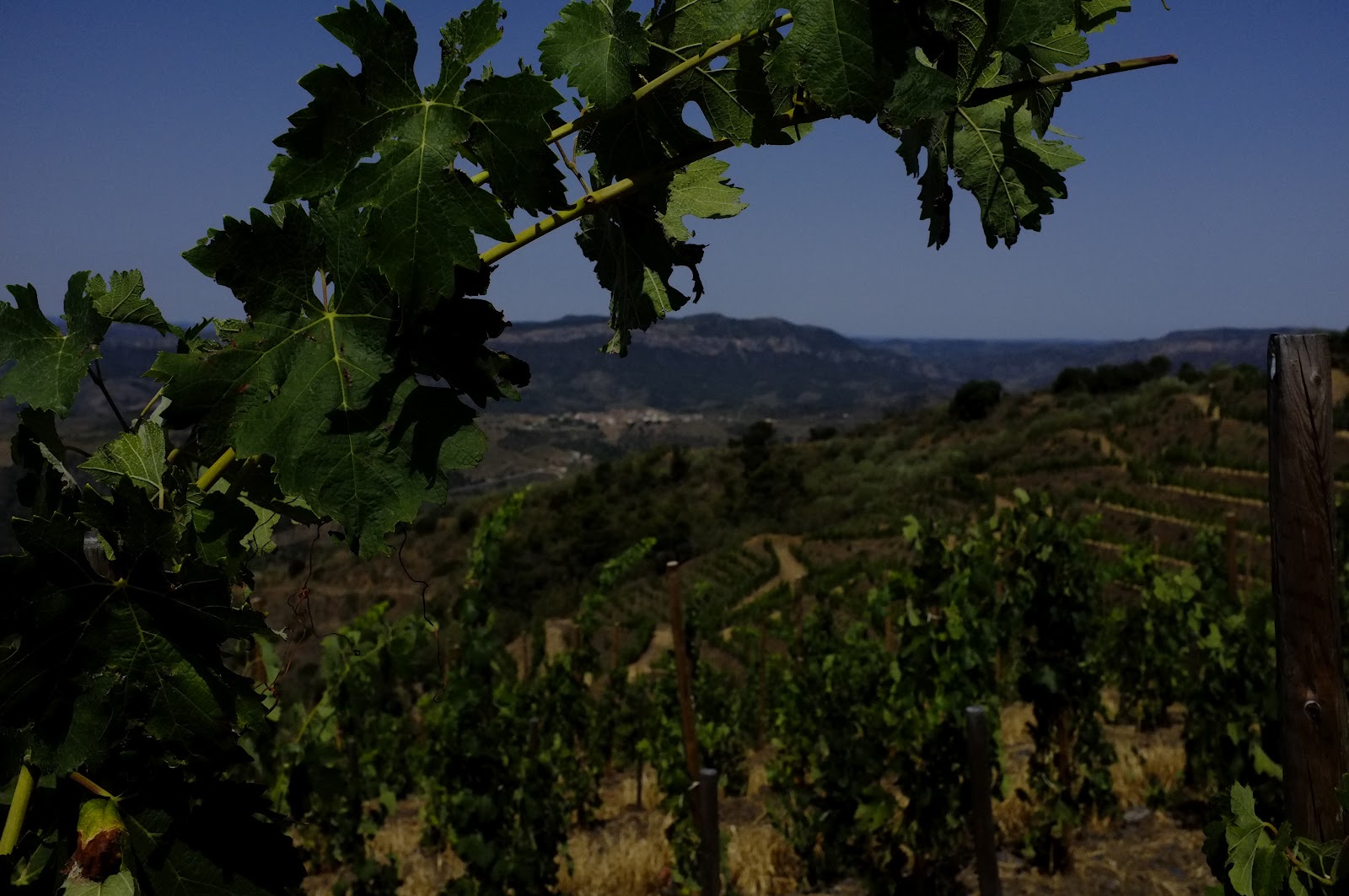 |
| The view from Mas Martinet's Escurcons vineyard. The highest in the region |
 |
| Licorella slate heavy soils in Priorat |
Wednesday, 11 July 2012
A look back at 96 Barolo & 01 German Riesling
Posted by Giles Burke-Gaffney, Buying Director
After a solid, reliable glass of Pol Roger Brut Reserve I attacked a flight of Kabinetts and Spatlesen. The tastebuds were well and truly tantalised, perhaps more than at any other point in the evening. Wehlener Sonnenuhr Kabinett from JJ Prum pleased immediately with its powerful savoury and gold-flecked fruit character, the Spatlese was of course richer but even livelier and beautifully seamless, Muller's Scharzhofberg Spatlese was typically smoky and searingly intense, an electric wine, however the wine of the flight, and indeed the whole evening was Brauneberger Juffer Sonnenuhr Spatlese from Fritz Haag. Though I was not the only one, neither was it everyone's top choice. The extremely high slate content of the vineyard means it won't ever be as forthright and powerful as JJ Prum and Muller's will always be more vital than almost any other Riesling. What the Haag offered, however, was great refinement, beauty and poise. We were lucky enough to continue with the wines over our starter, and it was the only glass I kept going back to.
The next course was a daunting flight of 1996 Barolos. La Serra & Brunate from Marcarini, Bric del Fiasc Scavino, Cannubi Boschis Sandrone, Monprivato G Mascarello, Barolo Falleto di Serralunga red label Giacosa and Barbaresco Santo Stefano Giacosa. 1996 is a vintage I have always loved, its sheer intensity and almost austere classicism but its not for the faint hearted. The wines proved that many 1996s are still babies, so open any you may have with caution (and hearty food!) The Falleto di Serralunga was, sadly, faulty and La Serra impossibly young, the rest, though, did all show glimpses of their excellence. The pick of the bunch for was the Bric del Fiasc, aromatic with a touch of oak and very ripe fruit, it has a sweetness to offset the structure that no other wine quite matched. It was, like the Sandrone, obviously more modern than the other wines but that not to the point of hiding its own unique character, it was just beautiofully crafted and perfectly balanced. Not far behind was the Santo Stefano from Giacosa, still very young, but loaded with fruit and savoury character, bound together by suave, noble tannins.
The (wine part of !) the evening came to a close with Auslese and Goldcap Auslese from JJ Prum and Haag. They were all clearly well crafted and had all of the necessary elements to them, but just seemed to fall a little flat. I felt they were even more adolescent than the 1996 Barolos, to my mind top Auslese only gets really interesting at 15 - 20 years of age, so I am sure more will eventually come from these....
Friday, 6 July 2012
Loire 2011 - So much quality, so much value...
Posted by Julian Campbell, Buyer |
| Chez...guess who? |
The mighty Loire, France's longest river, rises in the Cévennes and travels over 1000km heading first north and then west before reaching the Bay of Biscay and the Atlantic at St Nazaire. It would make a very fine bike ride. As it turns north-west and then west it plays host to one of the most diverse and perhaps underappreciated of France's great "wine regions". From the Marl and Kimmeridgean clay soils of Sancerre and the flinty, Silex strewn slopes of Pouilly Fumé via the Cabernet Franc friendly regions of Chinon, Bourgeuil and Saumur Champigny through dry, sweet and sparkling Chenin Blanc in Vouvray, Montlouis Anjou and Savennieres, right the way back to Sauvignon in Touraine and finally the Oyster partnering Muscadet towards its mouth. There is much to get excited about and many stellar domaines making world class wines at eminently affordable prices.
The 2011 vintage was, across the Loire, a vintage where careful vineyard management was vital. Growers up and down the region reported early flowering, prodigious fruit set and the danger of allowing yields to creep up to levels that would have prevented ripening. As elsewhere in France, the growing season was back to front; Summer came in Spring and Spring in Summer, with rainy spells through July and August and plenty of warmth. Perfect conditions for vigorous vegetal growth and the danger of potential rot. As a result, crop thinning, leaf plucking, yield management and patience at harvest were all vital to ensure healthy and most importantly ripe grapes were picked. It really is testament to the quality and commitment of our growers that the wines they have produced are of such high quality.
In Sancerre and Pouilly the 2011 Sauvignons may not be as racy as those in 2010, but they are no less intense and just as concentrated. And they have tremendous textural elegance. Giles Crochet and Serge Dagueneau provide the benchmarks in Sancerre and Pouilly respectively with beautifully balanced and rewarding wines of great purity and finesse. Also in Sancerre, Clement and Florent Pinard continue to push the envelope at their father's domaine producing a range of red and white Sancerre that surely must be some of the regions very best. The intensity and laser like precision of their 2011s is just staggering. As we left we found ourselves comparing their top cuvees to those of Domaine Didier Dagueneau. Say. no. more....
Further west more hard work was evident with a superb range of Cabernet Franc at Jacky Blot's tirelessly run Domaine de la Butte. Amongst other things, Jacky uses a primary up lit sorting table in the actual vineyard (and a second in the winery) to help sift out any less than perfect grapes at source. Given the prices these wines command this a serious demonstration of commitment to quality. And it shows. The wines at Charles Joguet, with a new winemaker as of 2010, have become a more supple, approachable and engaging. They are silkier now, more gourmande, and in my eyes at least, all the better for it. Over in Saumur Champigny, Phillipe Vatan at Ch. de Hureau, whose 11th Century caves are cut deep into the limestone "Tuffe", has once again produced a set of eminently pure and honest wines that keep you coming back for more.
Jacky Blot's world class Chenin's from Montlouis and Vouvray have once again produced the goods in 2011, though Jacky himself was the first to admit it was a “complicated” vintage. No fewer than 100 pickers were employed to allow precise and timely picking. The resulting wines are ripe, succulent and concentrated with crystal clear flavours. I am still drinking Remus Plus 2007 at home and it is absolutely breathtaking. These really are stand out value and deserve to be shouted about.
Last and by no means least, as of this year we have a new Chenin Blanc producer to rave about alongside Jacky Blot. Young up and coming star Thibaud Boudignon seems to be friends with all the right people. With just a few hectares in Anjou and Savennieres and a zealous belief in the importance of vine health, Thibaud is producing powerful yet silky wines that we are hugely excited to be adding to our list. His philosophy is hands on in the extreme and his attention to detail extends to ordering a particular barrel from Ramonet in Chassagne year on year. The only downside; he makes such tiny quantities. We’ll be offering the 2010’s shortly so watch this space. Word will be out soon...
Wednesday, 4 July 2012
Perrot Minot - an exciting find in Burgundy
Posted by Giles Burke-Gaffney, Buying Director
I am delighted and excited to finally be working with Christophe Perrot Minot. It is a Domaine I have been keeping an eye on for some time now with ever increasing interest but I was simply bowled over when tasting the final 2010 blends in Burgundy this Spring. After practising the profession of wine broker for seven years, Christophe Perrot-Minot took over his parent’s estate in 1993. As well as providing renewed vigour and a perfectionist’s approach to the winemaking, Christophe also succeeded in expanding the Domaine substantially by buying out the famous Pernin-Rossin estate in Vosne-Romanée, starting with the 2000 vintage. It took Christophe a while to find his way but in the last 5 years he seems to have settled on a style and really perfected it. The wines are ripe have a modern polish without losing their purity and combine intensity with elegance. They are far removed from the more structured Pinots of the Domaine’s early days. It seems that Burghound agrees, giving Perrot Minot some rave reviews over the last two vintages.
The greatness of a Domaine should always be judged on the quality of their wines in more “challenging” vintages. 2011 was not easy but any top Burgundian Domaine worth its salt should have made really seductive, attractive wines with enough structure to allow them to age well. I tasted Perrot Minot’s 2011s alongside the 2010s and was hugely impressed, they will no doubt rate as some of the vintage’s top wines. I can’t wait to get my hands on them!
A little overview of how Christophe goes about his work:
The viticulture is respectful to nature and terroir - no chemical fertiliser or herbicides are used. Low yields and Christophe’s eye for detail are fundamental to the great quality of the wines, in addition to the Domaine’s impressive army of old vines ranging from 40 to 100 years old. Everything is hand-picked, vine leaves and canopies are thinned during the season and sorting / grapes selections are rigorous. The grapes are, for the most part, de- stalked and after fermentation are aged in a maximum of 30-40% new oak. The wines are incredibly ripe, refined and concentrated, yet despite their almost modern intensity and polish they allow the nuances and character of terroir to come through strongly. A stellar Domaine.
Tuesday, 22 May 2012
2011 - An extraordinary German Riesling vintage
Posted by Giles Burke-Gaffney, Buying Director
This run of great German vintages is quite frankly embarrassing. 2011 is yet another. However the growers I met with on my buying trip to Germany last week certainly weren't blushing, they were too delighted with what they had in front of them. Karthauserhof's Christoph Tyrell thinks this will prove to be one of the benchmark vintages in the estate's 200 year history, producing 4 different cuvees each of BA and TBA, something they have never done before. Whilst Helmut Donnhoff considered the quality and health of the grapes "some of the best I have ever seen."
More detail will follow in our German Riesling 2011 offer that will be launched later than usual, in mid September, but in short this was a season that started early and finished as usual at the end of October and beginning of November. The "hang time" was therefore very long, thanks to unseasonably cool wet weather during the summer that slowed down an early Spring. This, the hot September and an October of uninterrupted sunshine have really made the vintage. A potential spanner in the works was hail at the end of August. The stones were reportedly somewhere between golf and tennis ball size but mainly effected roof tops and car windscreens (oh and one of Prum's neighbour's cats.) In the vineyards there was less concern, the stones being big enough to wipe out entire branches or bunches rather than leave individual, rot-inducing split berries on the vines. The fact that dry fine weather immediately ensued also helped to prevent the onset of rot. The Schaefers wryly commented "we had planned to carry out a green harvest at that time, but nature did it for us in the end!"
Growers struggle to compare the wines with other years, 2009 and 2007 being the closest they can get, but I don't feel this really does the 2011s enough justice. Thanks to the hot and sunny end of season this is another "powerful" and ripe vintage like 2009 but the wines are clearly different. For despite, analytically, betraying similar lower than average acidity levels, the wines taste fresh and very mineral. Terroir and vineyard definition are as transparent in the sweeter wines as I can ever remember them being over the last 10 years. The dry, sunny end of season meant that late harvest grapes were either shrivelled without the aid of botrytis or the noble rot that did appear was a very pure dry form. There are some great dry wines, powerful Kabinetts and utterly stunning Spatlesen and Auslesen. The Auslesen and BAs ranked among my favourite wines, though. The lack of traditional noble rot means they are not clouded but heavy honeyed and dried apricot richness, rather they are pure, bright and light in colour, intense - magnified versions of Kabinett and Spatlese. This to me makes it a uniquely German late harvest vintage, where the sweeter wines mix great intensity of flavour with a sublime delicacy. As August Kesseler says, "German Riesling on slate stands for lightness, intensity and drinkability." I could not agree more.
Friday, 27 April 2012
Bordeaux 2011 - The releases thus far...
Posted by Julian Campbell, Buyer
With the weekend upon us, (likely a long one in France), and Parker's scores out in the next few hours, herewith an easy to digest run down of all current Bordeaux 2011 releases of interest.
Wine
|
Price per case 12 bottles GBP
|
2011 Z, Bordeaux
|
50
|
2011 Croix Mouton, Bordeaux
Superieur
|
75
|
2011 Ch Beaumont
|
90
|
2011 Château Cissac, CB Haut Medoc
|
90
|
2011 Ch Villars
|
90
|
2011 Ch la Tour de By
|
120
|
2011 Ch Teyssier
|
120
|
2011 Ch Capbern Gasqueton
|
130
|
2011 Carmes de Rieussec
|
165
|
2011 Ch Rieussec
|
360
|
2011 Ch Poujeaux
|
190
|
2011 Chasse Spleen
|
195
|
2011 Ch Ormes de Pez
|
210
|
2011 Ch Cantemerle
|
220
|
2011 Doisy Vedrines
|
220
|
2011 Ch Haut Marbuzet
|
220
|
2011 Ch Rol Valentin
|
240
|
2011 Château Lafaurie
Peyraguey
|
275
|
2011 Ch Doisy Daene
|
290
|
2011 Ch Bellevue
|
380
|
2011 Ch Coutet
|
450
|
2011 Ch Gazin
|
450
|
2011 Ch Suduiraut
|
480
|
2011 Ch Climens
|
750
|
2011 Ch Cos d'Estounel
|
1200
|
2011 Ch Lafite-Rothschild
|
5500
|
2011 Bordeaux - Wine Advocate scores
Posted by Tom Jenkins, Bordeaux Buyer
As Bordeaux embarks on an unofficial four day weekend, there is plenty of time for everyone to digest the Wine Advocate notes. We don’t expect much activity for the next few days, so time to ponder Neal’s thoughts... Please find some highlights below.
2011 Chateau Leoville Barton 93-95
The Leoville Barton has a very elegant bouquet that takes time to unfurl. There are lovely notes of blackberry, dark plum and a touch of graphite. It unfurls beautifully if you lend it five minutes. The palate is very well balanced with fine tannins, good substance, very elegant and refined with a natural, slightly earthy finish that is long in the mouth. Superb persistency – this is one of the top Saint Julien wines. Tasted April 2012.
2011 Chateau Providence 91-93
Tasted at JP Moueix, the Providence 2011 has a precocious bouquet with dark cherries, crème de cassis and a touch of fig and apricot. Complex and exuberant, this is a more modern style of Pomerol but it retains fine delineation and focus. The palate is medium bodied with rounded tannins, a sense of sumptuousness and sensuality. Very well balanced, its red fruit caress the mouth and linger long. Oh là là! Tasted April 2012.
2011 Vieux Chateau Certan 96-98
The Vieux Chateau Certan was cropped between 6th and 7th of September and from 14th until 20th September. That’s what you’ll read everywhere, although I was filming Alexandre when he was picking the final Cabernet around the 29th September! Cropped at 37hl/ha, it is a blend of 70% Merlot, 1% Cabernet Sauvignon and (yay!) 29% Cabernet Franc. It delivers 13.6 degrees alcohol with a total acidity of 3.5gms/L and an IPT of 83. After the Cabernet Francless 2009 and 2010, this is more what I consider to be a classic VCC nose and as Alexandre, unlike those previous vintages that gives you everything up front, this is far more intellectual and enigmatic with hints of mineral laden fruit, limestone and small dark cherries. It is beautifully defined yet distant. The palate is succinctly balanced with crisp acidity, exceptional balance and superb backbone. There is an undercurrent of masculinity, a saline tincture, crushed stone and a touch of dried herbs and yet these are just fleeting hints. It has enormous length and it is one of the very few that could be on the same ethereal plateau as the 2009 and 2010 and perhaps one day...even better. Tasted April 2012.
2011 La Chenade 90-92
The La Chenade is a blend of 80% Merlot picked between 9th and 16th September and 20% picked on 19th September aged in 30% new oak. The nose is very fresh with a Burgundy-like purity and effervescence. The palate is medium-bodied with fine tannins, a lovely core of sweet red fruit laced with new oak, leading to a dark chocolate tinged finish. This is a top class La Chenade that could be as fine as the 2010. Another great wine courtesy of Denis Durantou. Tasted April 2012.
2011 Chateau l’Eglise-Clinet 94-96
Tasted at the property, Denis Durantou cannot really do wrong these days. The l’Eglise-Clinet 2011 was cropped between 12th and 15th September and the Cabernet Franc on 24th September, a blend of 90% Merlot and 10% Cabernet Franc being aged in 80% new oak. The nose is very elegant bouquet once left to unfurl over 10 minutes. It offers dark cherry fruits with touches of cassis and minerals: all very refined and poised. The palate is very well balanced with great precision on the entry. The Merlot is very expressive this year. The tannins are supremely fine and the finish linear and strict, offering traces of briary and minerals. There is a lovely femininity and sense of drinkability about this harmonious l’Eglise-Clinet that should be a worthy follow-up to the heavenly 2010. Tasted April 2012.
2011 La Petite Eglise 89-91
The Deuxieme Vin of La Petite Eglise is pure Merlot picked on 16th September that is aged in 50% new barrels. It has a refined bouquet with pure blackberry and raspberry with well-integrated creamy new oak that does not impede upon the fruit profile. With time it offers a touch of cedar that is very attractive. The palate is medium-bodied with impressive balance and a silky smooth texture. It has some oak to subsume so it will need 3-4 years in bottle, though it does not have the tension or persistency one can find in the 2009 or 2010. Still, this is very fine and probably will be good value. Tasted April 2012.
2011 Chateau Lafite-Rothschild 93-95
The 2011 Lafite-Rothschild is a blend of 80% Cabernet Sauvignon and 20% Merlot with an alcohol level of 12.6%. It has wonderful purity on the nose with blackberry, cassis, raspberry, a touch of graphite and an attractive floral note. It is feminine and beguiling. The palate is medium-bodied with supple tannins on the entry, crisp acidity, very harmonious and alluring with blackberry, raspberry and a saline touch towards the long caressing finish. It is a more sensual Lafite that I was expecting, with great persistency and poise. Tasted April 2012.
2011 Chateau Pichon Baron 93-95
A blend of 82% Cabernet Sauvignon and 18% Merlot picked from 12th September until 28th or something (according to a vague Mr. Seely.) It sports a ripe, more extrovert nose than some of its neighbours, with lush blackberry, boysenberry, a touch of cherry liqueur and underneath, typical Pauillac traits of graphite and tobacco. Leaving the glass for five minutes it unwinds nicely and shows great purity. The palate is medium-bodied with firm tannins on the entry, good grip and weight, a 2011 with real substance and chutzpah. The more I leave this in my glass, the more I like it. Very harmonious with layers of ripe blackberry and a touch of white pepper, the finish forgetting it is 2011 and not 2009. This is an outstanding Pichon Baron for the vintage. Tasted three times with consistent notes. Tasted April 2012.
2011 Chateau Pontet Canet 94-96
A blend of 60% Cabernet Sauvignon, 35% Merlot, 3% Cabernet Franc and 2% Petit Verdot, the 2011 Pontet Canet has a voluptuous bouquet with saturated dark cherry fruit, crème de cassis and a touch of blueberry with underlying minerality. It is exuberant, almost ostentatious at first, but it begins to calm down with time. The palate is medium-bodied with firm structured cloaked by layers of ripe black fruit infused with minerals and graphite. It is a quite a strict Pontet Canet underneath what is a hell of a lot of fruit for a 2011. The finish is composed with a touch of citrus fruit towards the finish. Amazing that such a good wine comes from 90% of the crop. Tasted April 2012.
2011 Chateau Haut-Brion 94-96
The Haut Brion is a blend of 34.8% Merlot, 18.9% Cabernet Franc and 46.3% Cabernet Sauvignon. The bouquet has a little more thrust than the La Mission with a little more opulence, although perhaps not the same degree of clarity and showing slightly more alcohol (but nothing to get concerned about.) It has good weight, firm rigid tannins and a weightier framework than La Mission. It is concentrated and generous with very good focus, a crescendo of flavours towards the finish and very good grip. A masterful Haut-Brion that is more voluminous than La Mission at present. Tasted April 2012.
2011 Chateau Smith Haut Lafitte 92-94
The Smith Haut Lafitte is a blend of 55% Cabernet Sauvignon, 36% Merlot and 8% Cabernet Franc aged in 60% new oak. The harvest (for the red) was between 15th September and finishing with the Cabernet Sauvignon and 30th September and it represents 39% of the crop. It has a lifted bouquet with ripe blackberry, cassis, black olive and fruits de mer with fine delineation. With continued aeration there is just a hint of violet. The palate is beautiful, very dense and concentrated with superb delineation and wonderful purity and minerality towards the finish. It is very long in the mouth. Excellent. N.B. This does not include the full vin de presse. Tasted April 2012.
All notes by Neal Martin for erobertparker.com
2011 Chateau Providence 91-93
Tasted at JP Moueix, the Providence 2011 has a precocious bouquet with dark cherries, crème de cassis and a touch of fig and apricot. Complex and exuberant, this is a more modern style of Pomerol but it retains fine delineation and focus. The palate is medium bodied with rounded tannins, a sense of sumptuousness and sensuality. Very well balanced, its red fruit caress the mouth and linger long. Oh là là! Tasted April 2012.
2011 Vieux Chateau Certan 96-98
The Vieux Chateau Certan was cropped between 6th and 7th of September and from 14th until 20th September. That’s what you’ll read everywhere, although I was filming Alexandre when he was picking the final Cabernet around the 29th September! Cropped at 37hl/ha, it is a blend of 70% Merlot, 1% Cabernet Sauvignon and (yay!) 29% Cabernet Franc. It delivers 13.6 degrees alcohol with a total acidity of 3.5gms/L and an IPT of 83. After the Cabernet Francless 2009 and 2010, this is more what I consider to be a classic VCC nose and as Alexandre, unlike those previous vintages that gives you everything up front, this is far more intellectual and enigmatic with hints of mineral laden fruit, limestone and small dark cherries. It is beautifully defined yet distant. The palate is succinctly balanced with crisp acidity, exceptional balance and superb backbone. There is an undercurrent of masculinity, a saline tincture, crushed stone and a touch of dried herbs and yet these are just fleeting hints. It has enormous length and it is one of the very few that could be on the same ethereal plateau as the 2009 and 2010 and perhaps one day...even better. Tasted April 2012.
2011 La Chenade 90-92
The La Chenade is a blend of 80% Merlot picked between 9th and 16th September and 20% picked on 19th September aged in 30% new oak. The nose is very fresh with a Burgundy-like purity and effervescence. The palate is medium-bodied with fine tannins, a lovely core of sweet red fruit laced with new oak, leading to a dark chocolate tinged finish. This is a top class La Chenade that could be as fine as the 2010. Another great wine courtesy of Denis Durantou. Tasted April 2012.
2011 Chateau l’Eglise-Clinet 94-96
Tasted at the property, Denis Durantou cannot really do wrong these days. The l’Eglise-Clinet 2011 was cropped between 12th and 15th September and the Cabernet Franc on 24th September, a blend of 90% Merlot and 10% Cabernet Franc being aged in 80% new oak. The nose is very elegant bouquet once left to unfurl over 10 minutes. It offers dark cherry fruits with touches of cassis and minerals: all very refined and poised. The palate is very well balanced with great precision on the entry. The Merlot is very expressive this year. The tannins are supremely fine and the finish linear and strict, offering traces of briary and minerals. There is a lovely femininity and sense of drinkability about this harmonious l’Eglise-Clinet that should be a worthy follow-up to the heavenly 2010. Tasted April 2012.
2011 La Petite Eglise 89-91
The Deuxieme Vin of La Petite Eglise is pure Merlot picked on 16th September that is aged in 50% new barrels. It has a refined bouquet with pure blackberry and raspberry with well-integrated creamy new oak that does not impede upon the fruit profile. With time it offers a touch of cedar that is very attractive. The palate is medium-bodied with impressive balance and a silky smooth texture. It has some oak to subsume so it will need 3-4 years in bottle, though it does not have the tension or persistency one can find in the 2009 or 2010. Still, this is very fine and probably will be good value. Tasted April 2012.
2011 Chateau Lafite-Rothschild 93-95
The 2011 Lafite-Rothschild is a blend of 80% Cabernet Sauvignon and 20% Merlot with an alcohol level of 12.6%. It has wonderful purity on the nose with blackberry, cassis, raspberry, a touch of graphite and an attractive floral note. It is feminine and beguiling. The palate is medium-bodied with supple tannins on the entry, crisp acidity, very harmonious and alluring with blackberry, raspberry and a saline touch towards the long caressing finish. It is a more sensual Lafite that I was expecting, with great persistency and poise. Tasted April 2012.
2011 Chateau Pichon Baron 93-95
A blend of 82% Cabernet Sauvignon and 18% Merlot picked from 12th September until 28th or something (according to a vague Mr. Seely.) It sports a ripe, more extrovert nose than some of its neighbours, with lush blackberry, boysenberry, a touch of cherry liqueur and underneath, typical Pauillac traits of graphite and tobacco. Leaving the glass for five minutes it unwinds nicely and shows great purity. The palate is medium-bodied with firm tannins on the entry, good grip and weight, a 2011 with real substance and chutzpah. The more I leave this in my glass, the more I like it. Very harmonious with layers of ripe blackberry and a touch of white pepper, the finish forgetting it is 2011 and not 2009. This is an outstanding Pichon Baron for the vintage. Tasted three times with consistent notes. Tasted April 2012.
2011 Chateau Pontet Canet 94-96
A blend of 60% Cabernet Sauvignon, 35% Merlot, 3% Cabernet Franc and 2% Petit Verdot, the 2011 Pontet Canet has a voluptuous bouquet with saturated dark cherry fruit, crème de cassis and a touch of blueberry with underlying minerality. It is exuberant, almost ostentatious at first, but it begins to calm down with time. The palate is medium-bodied with firm structured cloaked by layers of ripe black fruit infused with minerals and graphite. It is a quite a strict Pontet Canet underneath what is a hell of a lot of fruit for a 2011. The finish is composed with a touch of citrus fruit towards the finish. Amazing that such a good wine comes from 90% of the crop. Tasted April 2012.
2011 Chateau Haut-Brion 94-96
The Haut Brion is a blend of 34.8% Merlot, 18.9% Cabernet Franc and 46.3% Cabernet Sauvignon. The bouquet has a little more thrust than the La Mission with a little more opulence, although perhaps not the same degree of clarity and showing slightly more alcohol (but nothing to get concerned about.) It has good weight, firm rigid tannins and a weightier framework than La Mission. It is concentrated and generous with very good focus, a crescendo of flavours towards the finish and very good grip. A masterful Haut-Brion that is more voluminous than La Mission at present. Tasted April 2012.
2011 Chateau Smith Haut Lafitte 92-94
The Smith Haut Lafitte is a blend of 55% Cabernet Sauvignon, 36% Merlot and 8% Cabernet Franc aged in 60% new oak. The harvest (for the red) was between 15th September and finishing with the Cabernet Sauvignon and 30th September and it represents 39% of the crop. It has a lifted bouquet with ripe blackberry, cassis, black olive and fruits de mer with fine delineation. With continued aeration there is just a hint of violet. The palate is beautiful, very dense and concentrated with superb delineation and wonderful purity and minerality towards the finish. It is very long in the mouth. Excellent. N.B. This does not include the full vin de presse. Tasted April 2012.
All notes by Neal Martin for erobertparker.com
Subscribe to:
Posts (Atom)
